
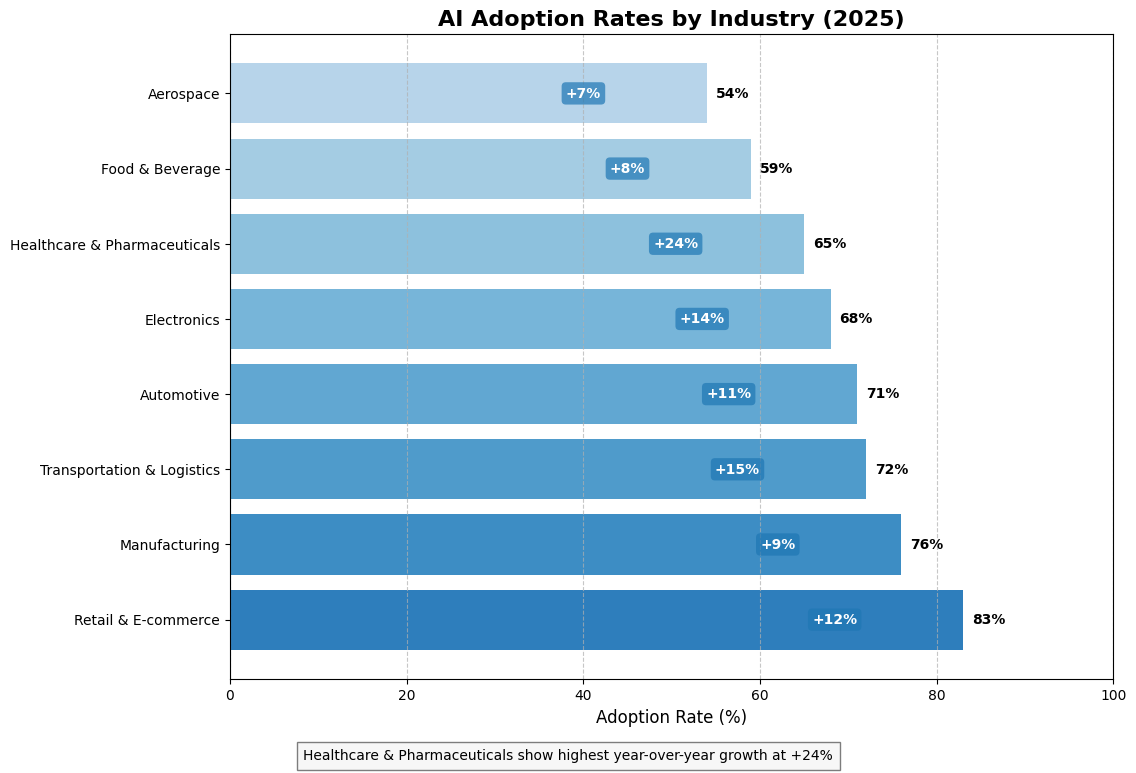
Artificial intelligence has transcended its origins as a research curiosity to become the defining technological force of the current decade. No longer confined to pilot projects or experimental labs, AI applications are now embedded in the operational fabric of global enterprises. For decision-makers, understanding where AI delivers tangible value—and where it merely adds complexity—is critical for strategic planning. This analysis examines the most impactful AI use cases across six major sectors, focusing on measurable outcomes and implementation nuances.
Healthcare: Precision Diagnostics and Operational Efficiency
In healthcare, the margin for error is measured in human lives. AI’s primary contribution lies in augmenting clinical judgment with pattern recognition capabilities that exceed human processing speed. The most mature applications target radiology, genomics, and hospital administration.
Diagnostic Imaging and Pathology
Deep learning models trained on millions of annotated scans now assist radiologists in detecting early-stage malignancies, hemorrhages, and micro-fractures. These systems do not replace the physician; they serve as a second reader that flags anomalies for review. For example, AI algorithms for diabetic retinopathy screening have achieved sensitivity rates above 90% in clinical trials, enabling early intervention in underserved populations where specialist access is limited.
Predictive Patient Monitoring
Hospitals deploy AI to analyze real-time vitals from ICU monitors. By correlating subtle changes in heart rate variability, oxygen saturation, and lab results, these systems can predict septic shock up to 12 hours before conventional scoring systems. This lead time allows care teams to initiate fluid resuscitation and antibiotic protocols earlier, directly reducing 30-day mortality rates.
Key benefit: Reduced diagnostic latency, lower readmission rates, and optimized bed utilization. Operational caution: Data privacy compliance (HIPAA/GDPR) and clinical validation against local patient demographics remain non-negotiable prerequisites.
Financial Services: Risk, Fraud, and Algorithmic Advisory
The financial sector has been a rapid adopter of AI due to its data-rich environment and high transaction volumes. Here, the technology delivers quantifiable ROI in three distinct areas: fraud detection, credit scoring, and automated compliance.
Real-Time Fraud Prevention
Traditional rule-based systems flag suspicious transactions after they occur. AI models, using supervised and unsupervised learning, analyze each transaction in under 50 milliseconds, building a behavioral profile for each account. Deviations—such as an unusual purchase velocity or atypical merchant geolocation—trigger immediate card blocking. The result is a reduction in false positives by up to 60% while catching novel fraud patterns that rules never explicitly encoded.
Alternative Credit Risk Assessment
For consumers with thin credit files, AI models ingest non-traditional data—including utility payment history, rental payments, and even digital footprint signals—to generate creditworthiness scores. This expands financial inclusion while maintaining default rate parity with conventional FICO models. Institutional lenders report a 15-20% increase in approval volume without a corresponding rise in delinquency.
| Fraud detection | False positive rate | -40% to -60% |
| Credit scoring | Loan approval rate | +15% to +20% |
| Robo-advisory | Asset allocation accuracy | +7% annual alpha (passive) |
| Compliance monitoring | Manual review hours | -70% |
Key benefit: Lower operational costs and stricter regulatory adherence. Critical consideration: Model explainability for audit trails—black-box models are unviable in most regulated jurisdictions.
Manufacturing and Supply Chain: Predictive Maintenance and Demand Sensing
Industry 4.0 has reshaped factory floors into sensor-rich environments. AI leverages this data to shift maintenance strategies from reactive to predictive, and supply chain planning from static to dynamic.
Predictive Maintenance
Vibration sensors, thermal imaging, and acoustic monitors feed into models that detect bearing wear, gear tooth spalling, and motor insulation degradation. When a model predicts a 85% probability of failure within 72 hours, maintenance crews intervene during scheduled downtime, avoiding catastrophic unplanned stops. Major automotive plants report a 30% reduction in downtime costs and a 25% extension in equipment lifespan.
Demand Forecasting and Inventory Optimization
AI forecasting models ingest sales history, macroeconomic indicators, weather patterns, and even social media sentiment. Unlike ARIMA-based linear forecasts, neural networks capture non-linearities—such as the surge in umbrella sales during a convective storm cell. This capability allows retailers to reduce stockouts by 25% while cutting excess inventory carrying costs by 15%, directly impacting EBITDA.
- Autonomous robots: Automated guided vehicles (AGVs) using SLAM navigation increase warehouse throughput by 40%.
- Quality inspection: Computer vision detects micro-defects on assembly lines with 99.7% accuracy, far surpassing human visual checks.
- Digital twins: Simulating entire production lines to test changes before physical implementation, reducing trial-and-error waste.
Retail and E-commerce: Hyper-Personalization and Dynamic Pricing
Consumer expectations for relevance have never been higher. AI systems allow retailers to treat every visitor as a unique segment of one, optimizing both conversion and lifetime value.
Recommendation Engines
Collaborative filtering and deep neural networks analyze browsing history, dwell time, cart abandonment, and purchase sequences. The output—real-time rank-ordered product suggestions—is rendered in under 100 milliseconds. Advanced systems move beyond “customers who bought X also bought Y” to session-based recommendations that account for the user’s current intent, such as “buying for a newborn” versus “restocking household staples.”
Dynamic Pricing Strategy
AI models adjust prices at SKU-level granularity based on competitor pricing, inventory levels, demand elasticity, and even time-of-day conversion patterns. Airlines and ride-sharing have pioneered this. In e-commerce, dynamic pricing can raise margins on high-demand items while automatically discounting slow-moving inventory to clear warehouse space.
Key benefit: Increased average order value (AOV) by 10-15% and improved customer retention metrics. Ethical note: Price discrimination algorithms require transparent opt-ins to avoid regulatory backlash.
Logistics and Transportation: Route Optimization and Autonomous Fleet Management
Logistics margins are thin; efficiency is king. AI provides the optimization layer that converts raw GPS and traffic data into actionable routing intelligence.
Last-Mile Delivery Optimization
Given 500 packages and 10 delivery vehicles, AI solvers consider traffic patterns, parking availability, package size, customer time windows, and even elevator wait times in buildings. The result is a multi-stop route that minimizes fuel consumption and driver overtime. Companies report a 12-18% reduction in miles driven per route, with a corresponding decrease in carbon emissions.
Autonomous trucking corridors
Level 4 autonomous trucks operate on fixed highway segments, handing over control to human drivers for city streets. This hybrid approach addresses the driver shortage while reducing long-haul fatigue accidents. AI perception systems fuse LiDAR, radar, and camera data to maintain safe following distances and anticipate sudden lane changes by other vehicles.
Agriculture: Precision Farming and Crop Yield Prediction
Agriculture faces the dual challenge of feeding a growing population while managing scarce water and soil resources. AI enables a data-driven approach to field management.
Soil and Crop Health Monitoring
Satellite imagery and drone-based multispectral sensors detect variations in chlorophyll content, nitrogen levels, and soil moisture. AI models then generate variable-rate application maps, telling seeder and sprayer equipment exactly how much fertilizer or pesticide to apply to each square meter. This approach reduces agrochemical use by up to 30% while improving yields by 5-10%.
Yield Forecasting
Before harvest, AI predicts final yield using growth stage data, historical weather patterns, and current soil conditions. Insurance companies utilize these forecasts for parametric crop insurance, triggering automatic payouts before visible signs of total loss—which is faster and more objective than manual adjuster visits.
Conclusion: Strategic Imperatives for Adoption
The aforementioned applications share a common denominator: they solve a concrete, high-value problem with a measurable ROI. Executives should evaluate AI not as a monolithic tool but as a portfolio of targeted capabilities. The following principles guide effective implementation:
- Start with data quality: AI is only as powerful as the data it trains on; invest in data governance before algorithm sophistication.
- Focus on narrow tasks: General-purpose AI is elusive; specialize in one workflow (e.g., invoice processing) rather than copying a competitor’s dashboard.
- Human-in-the-loop: For high-stakes decisions—medical diagnoses, loan rejections—keep a human reviewer for accountability and error correction.
- Measure continuously: Define baseline KPI before deployment and track the delta monthly; if no improvement in 90 days, pivot.
In summary, AI’s top applications across industries are not speculative. They are deployed, operational, and generating demonstrable business value today. The competitive advantage lies not in adopting AI for its novelty but in selecting the right problem where the data is sufficient, the process is well-understood, and the economic payoff is unambiguously positive. Organizations that internalize this discipline will lead their sectors; those that delay risk becoming cost-burdened followers.