
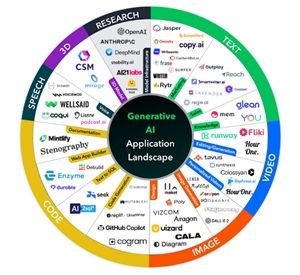
The landscape of generative artificial intelligence has evolved from experimental novelty to enterprise-grade utility in record time. For technology leaders, solution architects, and product managers, the ability to select the right generative tool is no longer a competitive advantage—it is a baseline operational requirement. This guide examines the most impactful generative AI tools across text, code, image, audio, and multimodal domains, providing a structured evaluation of their capabilities, limitations, and ideal use cases.
Text Generation and Language Models
Large language models (LLMs) remain the cornerstone of generative AI. Their applications span content drafting, summarization, translation, and complex reasoning. The following tools represent the current state of the art in text-based generation.
OpenAI GPT-4 and GPT-4 Turbo
OpenAI’s flagship models continue to set the benchmark for general-purpose language understanding and generation. GPT-4 Turbo offers a 128,000-token context window, enabling the processing of an entire book-length document in a single pass. Its function calling and JSON mode capabilities make it exceptionally well-suited for building structured AI workflows and agentic systems. The API is mature, with extensive documentation and a robust ecosystem of SDKs.
Key strengths: superior reasoning, broad knowledge base, high reliability, and extensive third-party integration. Primary limitation: cost per token remains higher than several open-weight competitors at scale.
Anthropic Claude 3 Opus and Sonnet
Claude 3 models are engineered with a strong emphasis on safety, nuanced instruction following, and long-context performance. Opus excels at complex analytical tasks and creative writing with a more natural, less robotic tone. Sonnet provides a faster, lower-cost alternative for high-volume production workloads. The 200,000-token context window is among the largest available commercially. For enterprise deployments that require rigorous safety filters and reduced hallucination rates, Claude is often the preferred choice.
Google Gemini Advanced
Gemini represents Google’s native multimodal architecture, processing text, images, audio, video, and code within a single model. The Ultra version competes directly with GPT-4 in reasoning benchmarks, while the integration with Google’s Vertex AI platform offers seamless deployment for organizations already invested in Google Cloud. For tasks requiring grounded, real-time information retrieval, its connection to Google Search provides a distinct advantage.
Code Generation and Software Engineering
Generative tools for software development have moved beyond autocomplete into autonomous code review, refactoring, and test generation. These tools are redefining developer productivity metrics.
GitHub Copilot and Copilot Chat
Built on OpenAI models and deeply integrated into Visual Studio Code, JetBrains, and the command line, Copilot remains the most widely adopted AI pair programmer. The tool suggests whole functions, generates boilerplate, and explains code snippets in natural language. The enterprise tier adds organization-level policy management and code-snippet exclusions for compliance-sensitive environments. Critical consideration: it is a productivity amplifier, not a replacement for code review; the generated code must still be validated for security vulnerabilities.
Cursor AI Editor
Cursor is a fork of VS Code that embeds AI into every interaction: multi-file edits, semantic code search, and chat with your entire repository context. Its “Composer” feature can orchestrate changes across dozens of files based on a single high-level instruction, dramatically reducing the overhead of large refactors. For teams that live in an IDE, Cursor offers the most aggressive code-generation workflow currently available.
Codeium
As a free, enterprise-ready alternative to Copilot, Codeium provides AI acceleration for over 70 programming languages. Its local deployment option makes it attractive for organizations with strict data-residency requirements. The tool also includes a standalone chat interface and an in-IDE context engine that can index your entire codebase for more accurate suggestions.
Image and Design Generation
Generative image synthesis has transformed creative workflows, enabling rapid prototyping of visual assets without manual illustration. The tools below lead in quality, control, and commercial viability.
Midjourney V6
Midjourney remains the gold standard for artistic quality and stylistic coherence. Its ability to generate photorealistic imagery, cinematic lighting, and complex compositions is unmatched. The platform operates primarily through Discord, which can be limiting for programmatic access, but the recent API release addresses this gap. For brand campaigns, mood boards, and high-fidelity concept art, Midjourney is the default choice. However, its prompt interpretation is less literal than competitors, requiring a learning curve.
Stable Diffusion XL and SD3
The open-source Stable Diffusion ecosystem offers unprecedented control through model fine-tuning, ControlNet for structural guidance, and LoRA adapters for style transfer. SD3, released by Stability AI, includes improved text rendering and multi-subject composition. Because the models are open-weight, developers can deploy them on private infrastructure—a non-negotiable requirement for organizations handling proprietary designs or healthcare imagery. The trade-off is a higher technical barrier to entry for optimal results.
Adobe Firefly
Firefly differentiates itself through commercial safety. It is trained exclusively on Adobe Stock and public-domain imagery, making it a legally defensible choice for commercial content. Integrated natively into Photoshop, Illustrator, and Express, Firefly offers generative fill, text-to-vector, and template-based creation. For design teams already in the Creative Cloud ecosystem, it provides the smoothest transition from manual to generative workflows.
Audio, Voice, and Music Generation
The audio domain has seen rapid maturation in both voice synthesis and music composition, with implications for media production, accessibility, and real-time communication.
ElevenLabs
ElevenLabs leads in text-to-speech with hyper-realistic voice clones, emotional intonation, and multilingual support. The platform’s “Voice Design” feature allows you to generate a unique synthetic voice from text descriptors alone, eliminating the need for voice actor recordings. Its latency is optimized for real-time streams, making it suitable for interactive agents and dubbing workflows. The Pro version offers 128kbps audio output at studio quality.
Suno AI
Suno is a generative music platform that creates complete songs—instrumentals, vocals, and lyrics—from a simple text prompt. It supports genre selection, tempo control, and custom lyric injection. For content creators, game developers, and podcasters, Suno provides a low-cost alternative to licensing commercial music libraries. The output quality is impressive for demos but may require post-production for professional releases.
Multimodal and Video Generation
Converging multiple modalities—text, image, audio, and motion—represents the next frontier. These tools are pioneering the generation of short-form video from natural language instructions.
Runway Gen-3 Alpha
Runway’s Gen-3 Alpha generates consistent, cinematic video clips up to 10 seconds in length with precise text-to-motion control. It supports inpainting, video-to-video editing, and motion brush features. The output resolution reaches 1280×720 at 24fps, with a clear path to 4K via upscaling. For advertising agencies and film pre-visualization, it enables the rapid iteration of dynamic storyboards.
Pika Labs
Pika offers a more consumer-friendly approach to video generation via its web app and Discord. It excels at stylized animation and meme-style effects, but its realism is behind Runway. Still, its ease of use and fast generation speed make it ideal for social media content teams and quick concept proofs.
Selection Framework and Comparative Analysis
Choosing the right generative AI tool is not about picking the “best” model—it is about matching capabilities to constraints. The table below summarizes key dimensions for the tools discussed.
| OpenAI GPT-4 Turbo | Text | 128k tokens | API / Cloud | General purpose agents, analytics |
| Anthropic Claude 3 Opus | Text | 200k tokens | API / Cloud | Complex reasoning, safety-critical tasks |
| Google Gemini Ultra | Multimodal | 1M tokens (beta) | API / Vertex AI | Video understanding, Search-grounded answers |
| GitHub Copilot | Code | N/A | IDE Plugin / SaaS | Inline code completion, boilerplate |
| Cursor AI | Code | N/A | Standalone IDE | Multi-file refactoring, repository-wide chat |
| Midjourney V6 | Image | N/A | Discord / API | High-artistic-quality visuals |
| Stable Diffusion XL | Image | N/A | Open-Weight / On-prem | Custom fine-tuning, private deployment |
| Adobe Firefly | Image / Vector | N/A | SaaS / Creative Cloud | Commercial-safe design integration |
| ElevenLabs | Audio | N/A | API / SaaS | Real-time speech, voice cloning |
| Suno AI | Music | N/A | SaaS | Full-song generation for content |
| Runway Gen-3 | Video | 10s clips | Cloud / API | Cinematic short-form video |
Strategic Recommendations
Organizations should avoid tool sprawl. Define a core stack of one text model, one code assistant, and one image generator, then add specialized tools based on validated business needs. For regulated industries, prioritize self-hostable open-weight models like Stable Diffusion or Codeium’s local deployment. For high-velocity product teams, the API-based models from OpenAI and Anthropic offer the most reliable scaling path.
Final consideration: generative AI tools are advancing on a quarterly basis. Establish an evaluation committee that re-assesses the landscape every six months, measuring latency, cost, output quality, and compliance against your specific use cases. The tools listed here are not a static list—they are the current leaders in a rapidly shifting competitive arena. Master their capabilities, but keep your architecture modular enough to integrate the next breakthrough without a complete overhaul.