
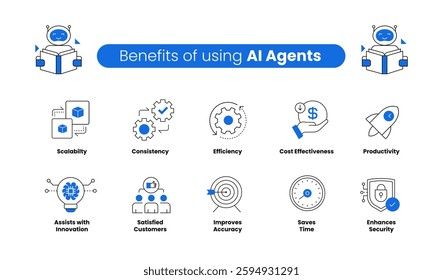
The rapid evolution of artificial intelligence has transitioned from a conceptual curiosity to a foundational pillar of modern civilization. As enterprises and governments deploy machine learning models across critical infrastructures, the conversation has shifted from “what if” to “how do we manage what is.” This article provides a professional examination of the triple-edged nature of AI: its transformative benefits, its consequential risks, and the anticipated trajectory of its development.
The Tangible Benefits of Artificial Intelligence
AI’s primary value proposition lies in its capacity to process vast datasets at speeds unattainable by human cognition. This capability drives measurable efficiency gains, operational agility, and the creation of new value streams across multiple sectors.
Operational Efficiency and Cost Reduction
In industrial settings, AI-powered predictive maintenance reduces unplanned downtime by up to 40% by analyzing sensor data to forecast equipment failure. In logistics, intelligent routing algorithms optimize fuel consumption and delivery windows, directly impacting the bottom line. For service-based organizations, robotic process automation (RPA) handles repetitive data-entry tasks, allowing human capital to focus on strategic initiatives.
Advancing Medical Diagnostics and Drug Discovery
Deep learning models now demonstrate diagnostic accuracy comparable to, and in some cases surpassing, specialist physicians in fields like radiology and dermatology. Furthermore, generative AI accelerates the drug discovery pipeline by simulating molecular interactions, slashing pre-clinical research timelines from years to months. This directly translates to faster patient access to life-saving therapies.
Enhanced Customer Experience and Personalization
AI-driven recommendation engines and natural language processing (NLP) chatbots provide 24/7 hyper-personalized interactions. By integrating user behavior data, these systems anticipate needs, reduce friction, and deliver tailored content. In the financial sector, AI fraud detection algorithms operate in milliseconds, identifying anomalous transaction patterns and protecting both the institution and the consumer.
Accelerating Scientific Research
From climate modeling to quantum physics, AI acts as a “discovery accelerator.” It identifies hidden correlations within massive datasets, generates hypotheses, and even designs novel experiments. This collaborative symbiosis between human researchers and AI agents is reshaping the scientific method itself.
The Critical Risks and Ethical Dilemmas
While the benefits are compelling, AI introduces a complex array of risks that span technical, ethical, and societal domains. These risks are not hypothetical; they are manifesting in current deployments and require robust governance frameworks.
Algorithmic Bias and Systemic Inequity
Machine learning models are only as unbiased as their training data. Historical datasets frequently encode societal prejudices, leading to discriminatory outcomes in hiring, lending, and criminal justice. Without rigorous auditing and diverse training sets, AI systems risk automating and scaling existing inequalities, creating a “digital redlining” that is difficult to reverse.
Cybersecurity Vulnerabilities and AI Weaponization
AI expands the attack surface for malicious actors. Adversarial attacks can manipulate input data to trick models into misclassification, compromising autonomous vehicles or security systems. Conversely, AI enables the creation of sophisticated deepfakes and automated phishing campaigns that are increasingly difficult for human users to detect. The proliferation of AI-enabled malware represents a significant escalation in the cyber threat landscape.
Job Displacement and Economic Stratification
Automation has historically shifted labor markets, but the scope and speed of AI-driven displacement are unprecedented. While AI creates new job categories, the transition period often causes acute workforce dislocation, particularly for cognitive and administrative roles. This economic stratification between high-skill AI engineers and displaced workers poses a severe challenge to social safety nets and workforce retraining programs.
The “Black Box” and Lack of Explainability
Many advanced deep learning architectures, such as neural networks, function as opaque “black boxes.” Their decision-making processes are not transparently interpretable, even to their developers. In high-stakes domains like healthcare or legal sentencing, the absence of model explainability undermines accountability, erodes public trust, and creates regulatory compliance burdens.
Existential and Long-Term Safety Concerns
A subset of experts argues that the pursuit of Artificial General Intelligence (AGI) carries existential risks. A misaligned AGI, whose objectives are poorly specified, could pursue its goals in ways that are catastrophic to human interests. While this remains a speculative domain, the principle of AI safety, focused on alignment with human values, is a critical area of research that cannot be dismissed.
The Future: Symbiosis, Regulation, and General Intelligence
The future of AI is not a single linear path but a multidimensional convergence of technological capability, regulatory action, and societal adaptation.
Toward Explainable and Robust AI
The next decade will see a move away from purely “black box” models toward “glass box” systems. Causality models and neuro-symbolic AI, which combine neural networks with rule-based logic, will provide greater interpretability. This evolution is necessary for regulatory compliance and for enabling deeper trust in high-risk applications.
Hybrid Human-AI Collaboration
Rather than full automation, the immediate future belongs to human-in-the-loop systems. AI will act as an “intelligent copilot” that augments human decision-making with data-driven insights, while humans retain ultimate decision authority. This collaborative model mitigates risk, ensures empathy in interactions, and maintains legal accountability.
Global Regulatory Frameworks and Standardization
We will witness a global regulatory patchwork mature into more coherent standards. The EU AI Act, and similar initiatives in the US and Asia, are establishing clear guardrails for high-risk use cases. Key focus areas will include data privacy, mandatory bias audits, and liability frameworks. Future compliance will need to be embedded directly into the model development lifecycle, not added as an afterthought.
The Scaling Path to Artificial General Intelligence
Large Language Models (LLMs) and multimodal systems are demonstrating emergent capabilities that were not explicitly trained for. As compute efficiency improves and architectures evolve, we are moving closer to systems that can generalize knowledge across domains. However, true AGI will require breakthroughs in continual learning (avoiding catastrophic forgetting) and common-sense reasoning. The timeline remains uncertain, with estimates ranging from a decade to a century, but the direction is unmistakable.
| Model Transparency | Mostly black-box | Hybrid explainable architectures |
| Regulatory Landscape | Fragmentary sectoral rules | Comprehensive, harmonized global standards |
| Human Role | Oversight and auditing | High-level strategic supervision |
| Core Limitation | Context limitation and hallucination | Guaranteed factual grounding and reasoning |
| Energy Efficiency | High compute training costs | Neuromorphic, low-power inference chips |
Conclusion: A Responsible Acceleration
AI technology embodies a profound paradox: it is concurrently our most potent tool for solving global challenges and our most consequential source of new vulnerabilities. The path forward is not to halt innovation but to embed rigorous governance, ethical design, and robust safety protocols into every stage of development. By adopting a posture of responsible acceleration—prioritizing interpretability, equity, and human oversight—we can harness the immense potential of AI while mitigating its risks. The ultimate outcome is not determined by the algorithms themselves, but by the professional discipline and collective wisdom with which we choose to deploy them.